


Dulse Seaweed / Spring / Summer / Autumn / Edible
Common Names
Red seaweed, Dillisk, Vegan’s Bacon, Creathnach
Botanical Name
Palmaria palmata
Scientific Classification
Kingdom – Plantae
Order –Palmariales
Family – Palmariaceae
Habitat
Northern coasts of the Pacific and Atlantic oceans and their associated seas.
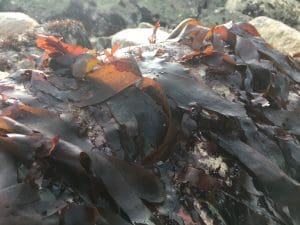
Prefers to grow on rocks, creatures and other seaweeds that spend most of their time submerged by the tide.
From April to November you should find plenty. Best to time your harvest for the two hours around the lowest tide, ideally at one of the extra low tides of the new moon.
Physical Characteristics:
Fronds
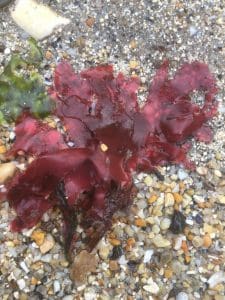
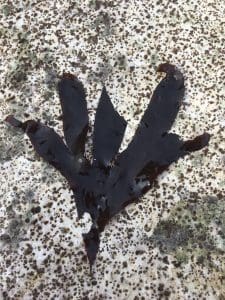
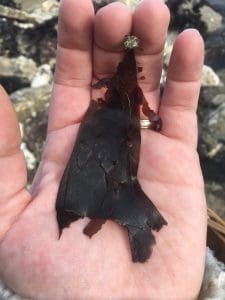
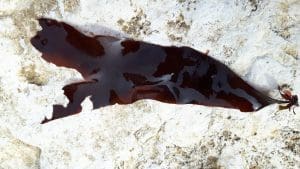
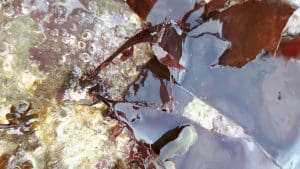
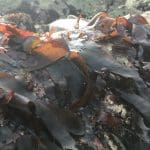
Flat, translucent, notably red ‘fingers’ that branch irregularly from a central holdfast. Think thin rashers of cured meat. Size varies from a small handful to a large fistful.
Holdfast
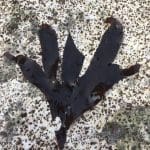
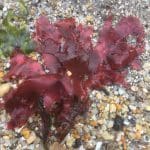
The holdfast is small, discoid (disc-shaped) and tough. It anchors the seaweed firmly to rocks or other seaweeds, often kelps.
Known Hazards
As with most seaweeds, the high iodine content means that those with thyroid issues should be careful not to consume too much if they are already taking iodine supplements. Likewise, the salt content may be a problem for those who need to limit their salt intake. In general, there are more hazards associated with the environment you find it in than from the algae itself. It is wise to check water quality data from the Environment Agency (https://environment.data.gov.uk/bwq/profiles/ ) to see whether there are issues with chemical or sewage pollution in the water, and to rinse your harvested seaweed well with clean water to be on the safe side. You should also be aware of slippery or unstable rocks, and the possibility of the sea coming round quickly and cutting you off from land. Check the tide times, only harvest from areas you can get to safely, and take someone with you to get help if you get into difficulty.
Could Be Confused With
Could be confused with Laver (Porphyra-spp), but Dulse has a distinctive red hue and is slightly thicker to touch than Laver, which feels very much like organic latex or stretchy clingfilm. Research the cleanliness of the waters you intend to harvest from – not just for sewage but also for toxic algal blooms. Beware of eating from the British seas during winter due to higher overflow rates.
Edible Uses
First and foremost Dulse makes an excellent forager’s snack, right there in the rock pools.
Of course ensure that you have researched the cleanliness of the water you are gathering from beforehand, and do not do this in winter when higher rainfall means a higher likelihood of sewage discharge from the main system.
Dulse is a delicious addition to stir-fries, salads, quiches, pies, bakes and more if you’re looking for a vegetable that brings its own seasoning, and is incredibly useful as a soup/stew thickener due to its high carbohydrate content.
The best way to take advantage of its thickening properties would be to dry and powder it before adding it to your dish. Perhaps a cheese souffle would work well.
Dulse also makes delicious seaweed crisps, either battered with a light gram flour batter and deep-fried for seconds, or crisped with olive oil under a grill.
It can also be dried thoroughly and crumbled up as a seasoning that doubles as a nutritional supplement. Red seaweeds are particularly high in protein, so feature well in vegan, vegetarian, and otherwise restricted diets. They should be consumed moderately, for reasons discussed in the safety section above.
Notes on Herbal uses
The importance of maintaining a proper level of minerals, vitamins and other micro nutrients cannot be underestimated, particularly in modern times when our industrialised food system means that fruits and vegetables lack the nutrients they once contained. Lack of proper nutrition leads to chaos in the body, which might manifest as inflammation, pain, autoimmunity, low mood, and any other chronic process of ill health. The body literally does not have what it needs to function smoothly. Seaweeds, like many other wild foods but especially so, are incredibly rich in essential nutrients, and moderate long-term consumption can lay the foundations for good health. Clinically, medical herbalists might reach for seaweeds in particular skin issues, skeletal issues and malnutrition.
Conservation Considerations
Very common in the UK and around the world – be sensible in the amount you take at any given time.
Extra notes from the Foragers
Like almost any plant that is available near water, it is said that Dulse has been used by sailors to ward off scurvy due to its high vitamin C content, alongside other vitamins and minerals.
Click here to explore more Seaweed guides
Leave a Reply
You must be logged in to post a comment.