


Bladderwrack / Spring / Summer / Autumn / Winter / Edible
Common Names
Rockweed, Seawrack
Botanical Name
Fucus vesiculosus
Scientific Classification
Kingdom – Chromista
Order –Fucales
Family – Fucaceae
Habitat
This seaweed likes to be between the high and low watermarks, spending a fair amount of time submerged.
Found across Britain on its rocky shores. Easily found on rocky shores in the Americas and Europe.
This seaweed likes to be between the high and low watermarks, spending a fair amount of time submerged.
Physical Characteristics:
Fronds
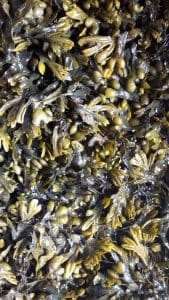
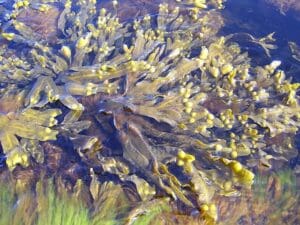
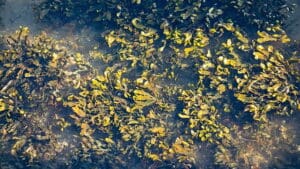
This is a brown seaweed that can vary massively in size, from a few fronds 15cm in length to countless boulders covered with metre long fronds.
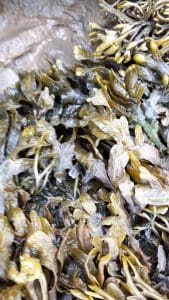
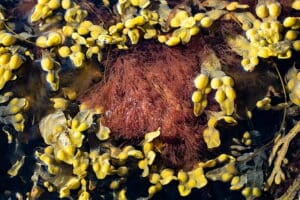
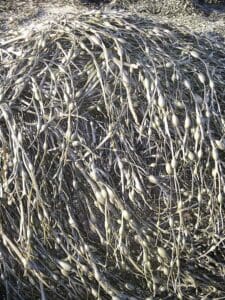
Like many of the wracks, it is organised into strappy fronds that have bladders – literally pockets of air, or sometimes gel – which function to assist in flotation. In this species, the bladders often appear in pairs beside the prominent mid-rib running down the centre of the frond, and the edges are notably non-serrated.
The number of bladders varies with wave action; more waves leads to fewer bladders that tend to be located at the end of the frond, and vice versa. Look at many different images of bladderwrack to instil the pattern into your mind.
The fronds tend to be covered in a layer of mucilage – sticky carbohydrate – that helps to protect the algae from temperature and desiccation stress.
Holdfast
The holdfast of bladderwrack is disc-shaped and basal.
Known Hazards
As with most seaweeds, the high iodine content means that those with thyroid issues should be careful not to consume too much if they are already taking iodine supplements. Likewise, the salt content may be a problem for those who need to limit their salt intake. In general, there are more hazards associated with the environment you find it in than from the algae itself. It is wise to check water quality data from the Environment Agency (https://environment.data.gov.uk/bwq/profiles/ ) to see whether there are issues with chemical or sewage pollution in the water, and to rinse your harvested seaweed well with clean water to be on the safe side. You should also be aware of slippery or unstable rocks, and the possibility of the sea coming round quickly and cutting you off from land. Check the tide times, only harvest from areas you can get to safely, and take someone with you to get help if you get into difficulty.
Could Be Confused With
Many of the wracks appear similar, and for the purposes of culinary use, it’s only a matter of taste.
Once you start looking at them closely, you’ll find that you notice the distinguishing details, such as the serrated edges of the serrated wrack, the large bulbous bladders of egg wrack, and the distinctive frond divisions of horned wrack.
Edible Uses
This is a true sea vegetable, with plenty of body and saltiness but without the striking meaty flavours of some of the red seaweeds.
Grill with a drizzle of oil and a sprinkle of pepper for a delicious snack, stir fry into pasta and vegetable dishes, including in stews and sauces, or steam and serve with chilli and sesame seeds as a salad, for example.
You will probably see bladderwrack all year around. Make sure to cut what you gather away from the rest of the colony to avoid damaging its chances of reproducing but also to avoid getting grit and dirt in your food!
The bases of the fronds nearest the holdfast tend to be very fibrous, so best to slice away the first few inches which are softer and fresher.
Notes on Herbal uses
Bladderwrack contains high concentrations of iodine, which is essential for proper thyroid function, and therefore for metabolic health. Include a moderate amount frequently in your diet to obtain the benefits.
It also contains other minerals and a host of carbohydrates that moderate the function of the immune system.
Conservation Considerations
Although it is very common on most of Britain’s rocky coastlines. Treat the algae with care, never pulling them completely away from their holdfasts, thereby giving them the best chances of reproducing. Wracks provide food and habitats to many rock-pool creatures like grazing molluscs and tiny fish.
Extra notes from the Foragers
Bladderwrack, being so abundant, is now a source for compounds added to face creams, reportedly for their anti-ageing qualities. It was previously a source of industrial and medical iodine.
Click here to explore more Seaweed guides
Leave a Reply
You must be logged in to post a comment.