
Kelp / Spring / Summer / Autumn / Winter / Edible
Common Names
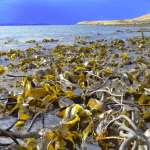
Kelp refers to a group of brown seaweeds that have a very sturdy, handlike holdfast, a long stipe (stalk), long fronds and a tendency to grow in dense clumps that look like underground forests in the right conditions. Thus, there are several common names that fall under the umbrella term ‘kelp’.
Botanical Name
Laminaria species
Scientific Classification
Kingdom – Chromista
Order –Laminariales
Family – Laminariaceae
Habitat
Britain has one of the widest variety of kelps in Europe due to its abundant coastline and varying habitats. Kelps like to holdfast to solid rocky seabed, and need a fair amount of light, so tend to live in the shallows. If the conditions are right, they will form large clusters often called kelp forests.
Physical Characteristics:
Fronds
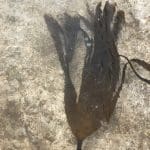
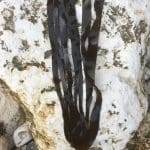
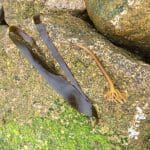
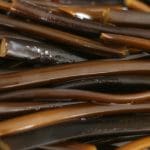
Large, brown seaweeds with a solid stipe, and a hand of several long, smooth fronds that can be well over a metre long. Some fronds develop bladders full of air to help them float in the currents.
Holdfast
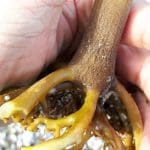
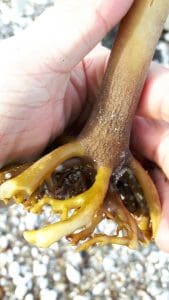
The holdfast is large, branched, and root-like (haptera).
Known Hazards
As with most seaweeds, the high iodine content means that those with thyroid issues should be careful not to consume too much if they are already taking iodine supplements. Likewise, the salt content may be a problem for those who need to limit their salt intake. In general, there are more hazards associated with the environment you find it in than from the algae itself. It is wise to check water quality data from the Environment Agency (https://environment.data.gov.uk/bwq/profiles/ ) to see whether there are issues with chemical or sewage pollution in the water, and to rinse your harvested seaweed well with clean water to be on the safe side. You should also be aware of slippery or unstable rocks, and the possibility of the sea coming round quickly and cutting you off from land. Check the tide times, only harvest from areas you can get to safely, and take someone with you to get help if you get into difficulty.
Could Be Confused With
All kelps like Oarweed (Laminaria digitata) and forest kelp can be used in a similar way, and no seaweed species that grows on the shores of Britain are currently toxic. This may change with shifting climate patterns.
Edible Uses
This is a very versatile group of seaweeds, with their large surface area and crunchy texture making them a perfect addition to or substitution for lasagne sheets. They can be incorporated into pies, fries, quiches and bakes. The fronds are also very tasty after battering in a light batter such as gram flour, or crisping under the grill with some olive oil and pepper. You could also dry and powder kelp to make a soup thickening and flavouring agent.
Notes on Herbal uses
Like all seaweeds, kelps are high in iodine and many other essential minerals and vitamins. These compounds are essential for good long term metabolic function, which supports the health of every system in the body. Consume in moderation, and consult a healthcare practitioner if you increase your seaweed intake while taking thyroid medication.
Conservation Considerations
Kelp forests are important physical features of the seabed because they can attenuate the strength of waves reaching the shore. They are therefore important systems to conserve as the climate changes and weather systems become more extreme, but are unfortunately quite intolerant to changes in water temperature.
Only harvest the fronds if you have found some still attached, or else take what has been washed up very recently so that it is still fresh.
Extra notes from the Foragers
In traditional folklore some thought it could protect against evil spirits if hung in the home, because of its “magical, jelly-like” resilience.
Click here to explore more Seaweed guides
Leave a Reply
You must be logged in to post a comment.