
Hairy Curtain Crust / Spring / Summer / Autumn / Winter / Inedible
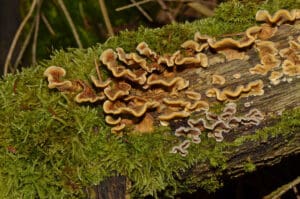
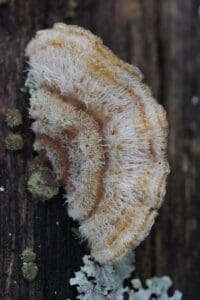
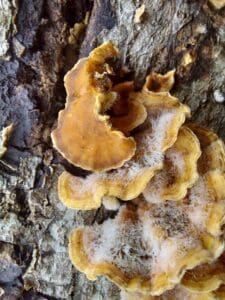
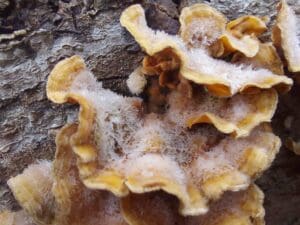
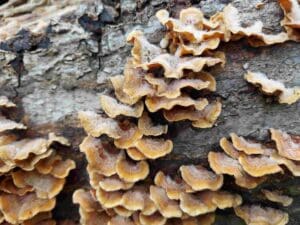
Through this post we’re going to be delving into the Hairy Curtain Crust Fungi that is sometimes confused for the Turkey Tails Mushroom.
If you’re anything like me, the sight of fungi peeking out from tree trunks and fallen logs on a woodland walk is always a moment of curiosity and wonder. There’s something magical about the variety of shapes, colours, and textures these hidden gems bring to the forest floor.
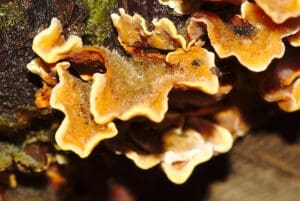
One I come across really often is the charming Stereum hirsutum, or hairy curtain crust. It’s not the showiest fungus in the woods, but once you’ve noticed it, you’ll start spotting its delicate, fan-like forms everywhere. Clinging to decaying wood, it seems to drape itself over the surface, its tiny, velvety hairs catching the light.
Scientific Name
Stereum hirsutum
Common Name
Hairy curtain crust fungus, false turkey tail
Family
Stereaceae
Habitat
Saprophytic growing of dead hardwood particularly oak and beech, occasionally conifer trees.
Never out the ground
Is apparently a parasite on peach trees.
Can be seen all year, but growing in damper conditions and sporulating in autumn.
Identifying Features
This is a bracket polypore fungus that grows directly off wood usually in dense horizontal overlapping clusters.
Shape
No stem. The fruiting body is fan shaped 2-8cm wide, very thin- only 1mm thick. had a wavy uneven margin
Flesh
tough but flexible like rubber
Stem
This fungus has no stem
Upper side
Radial bands of colour in shades of off white, ochre, orange and browns.
Bracket surface is slightly hairy as the name suggests.
Underside
Polypore- lots of tiny holes like sponge. Off ochre/orange turning beige with age.
Smell:
No notable odour or taste, it’s very slightly mushroomy
Spores
white
Known hazards
None known
Potential lookalikes
This is most commonly misidentified for Turkey tail giving it its common name false turkey tail. The main differences are turkey tail is more commonly in shades of blues, is not hairy and the underside is pure white as a pose to off orange/ochre.
Uses
Inedible so not a culinary mushroom but is said to have some medicinal properties
It has potential as a blood thinning medication due to its inhibitory activity on thrombin (a crucial enzyme in blood clotting)
Has been used environmentally to aid decontamination of BPA in river water
Possess epidioxysterols that show significant effect against TB
Clinical tests have shown it has food antioxidant properties
Extra Notes from the foragers
Has obtained its name Stereum hirsutum though stereum which means ‘tough’ and hirsutum meaning hairy
A fungus called Tremella aurantia paratasizes hairy curtain crust fungus
Resources
Nature-first.com