
Oak Polypore / Spring / Summer / Autumn / Winter / Inedible
Scientific Name
Inonotus dryadeus
Common Names
Oak Polypore, Oak Bracket, Weeping conk and Warted Oak Polypore
Family
Hymenochaetaceae
Habitat
An infrequent find in northern Britain but fairly common in Wales and southern England. They are parasitic and are found near the base of living and dead oak tree’s and occasionally on other broad-leaf trees such as beech and birch.
Description
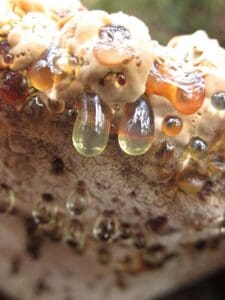
The oak bracket fungus doesn’t really have any specific uses, apart from playing a vital role in the woodland ecosystem but they are amazing to find especially when they’re dripping with ‘honey’!
Identifying Features:
Cap:
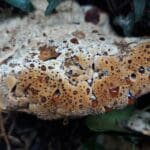
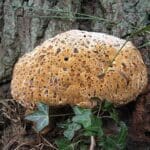
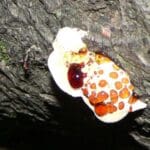
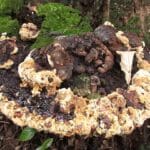
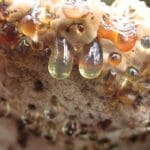
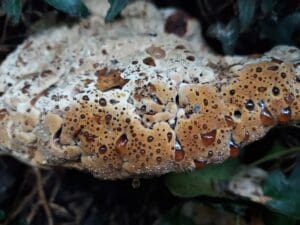
The bracket is up to 65 cm across and typically 10–15 cm thick. The upper surface is cream to rusty brown and velvety or hairy. When young and fresh, amber-coloured droplets ooze from tiny pores in the dimpled surface, especially around the edge. the liquid it secretes makes the bracket look as if it is dripping honey. Please don’t taste it, trust me the similarities end there! As the bracket ages, it starts to smell pretty unpleasant. They are more often found singularity but do sometimes occur in tiers.
Its rusty brown flesh is soft at first, becoming corky and fibrous with age. The caps become blackened and cracked over winter, and sometimes persist for several years.
Pore/tubes:
The underside is buff in colour and there are 4 to 6 fine pores per millimetre. These are initially greyish-white but mature to yellow.
Smell:
Unpleasant especially as they age.
Spores:
White.
Known hazards
Not thought to be toxic but they are tough and bitter making them inedible.
Potential lookalikes
Could possibly be confused with the Beefsteak Fungus (Fistulina hepatica) which also grows on Oak trees but this has a softer texture and oozes red juice when cut.
The Shaggy Bracket (Inonotus hispidus) looks very similar but this is usually found growing on Apple or Ash rather than Oak, has a much smoother surface and has a brown spore print.
References:
https://www.woodlandtrust.org.uk/trees-woods-and-wildlife/fungi-and-lichens/oak-bracket/
https://www.first-nature.com/fungi/pseudoinonotus-dryadeus.php