


Irish Moss Seaweed /Autumn / Winter / Spring / Edible
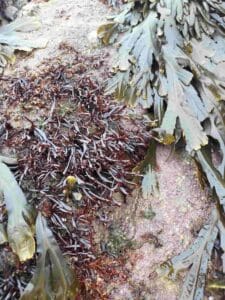
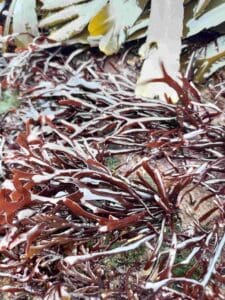
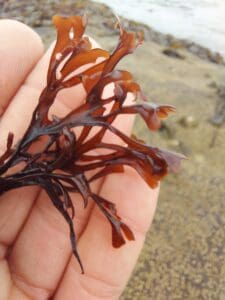
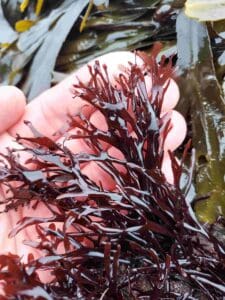
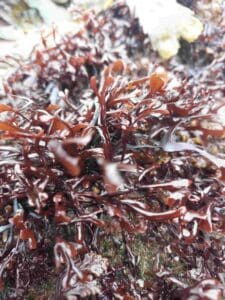
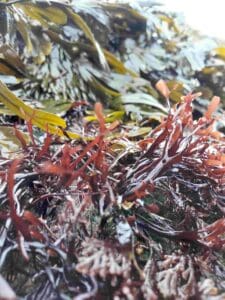
Note: You may have heard more about Carrageenan than about Irish Moss, and you may be surprised to find controversial material after googling carrageenan! Irish Moss is the seaweed from which the fibre/carbohydrate carrageenan is extracted. The information below relates to eating the entire seaweed, unextracted, whereas lots of online information is about the extracted fibres carrageenan, poligeenan etc. Extracted carrageenan is used in the food and cosmetics industries as a thickener, stabiliser and texture enhancer.
Common Names
Sea Moss, Carrageen
Botanical Name
Chondrus crispus
Scientific Classification
Kingdom – Chromista
Order – Gigartinales
Family – Gigartinaceae
Habitat
It grows on rock from the subtidal to intertidal zone across the British Isles. Further towards the ocean floor, the colour will become darker red.
Physical Characteristics:
Fronds
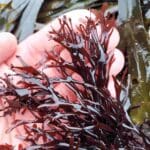
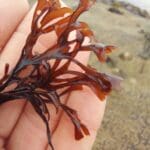
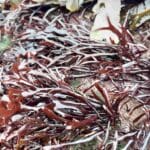
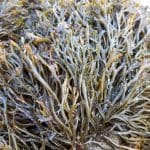
A small red alga that generally grows to about 20cm in length. The fronds tend to branch/fan out four times and end in small pointed horns. Irish moss is quite variable, and it can take some practice to distinguish it from the other small red seaweeds. Closer to the shore, the colour can change to be more green or even yellow, particularly at the tips.
Holdfast
he holdfast is small, discoid (disc-shaped), and slightly flattened.
Known Hazards
As with most seaweeds, the high iodine content means that those with thyroid issues should be careful not to consume too much if they are already taking iodine supplements. Likewise, the salt content may be a problem for those who need to limit their salt intake. In general, there are more hazards associated with the environment you find it in than from the algae itself. It is wise to check water quality data from the Environment Agency (https://environment.data.gov.uk/bwq/profiles/ ) to see whether there are issues with chemical or sewage pollution in the water, and to rinse your harvested seaweed well with clean water to be on the safe side. You should also be aware of slippery or unstable rocks, and the possibility of the sea coming round quickly and cutting you off from land. Check the tide times, only harvest from areas you can get to safely, and take someone with you to get help if you get into difficulty.
Another note on carrageenan: you will see content online about the health risks of consuming large amounts of carrageenan from foods that have required emulsifying and otherwise processing. Too much of anything is a problem, and it may be that people already living with digestive issues and microbiome dysbiosis should steer clear of processed foods containing high concentrations of carrageenan. Keep in mind that this controversy relates to a single molecule derived from Irish Moss – these claims and data do not necessarily relate to consuming the entire seaweed, which is made up of thousands of other molecules and minerals, many of which are highly beneficial if consumed in context and moderation. If you have more concerns or queries about this, consult a healthcare provider such as pharmacist, GP or medical herbalist.
Otherwise, take care with increasing your seaweed consumption if you take thyroid medication. Do your homework on the water quality from which you harvest you algae – the UK government has been allowing a greater number of untreated combined sewage discharges for the past couple of years (as of 2022). Wash your weed and cook it well when you get home as a rule of thumb if harvesting during the winter (greater water volumes flowing through the sewers – greater overflows).
Could Be Confused With
A particularly similar species is Grape Pip Weed, also sometimes known as false carragheen (Mastocarpus stellatus). It often grows alongside Irish Moss, and it’s not an issue if you pick the other – it can be used in the same ways, but the flavour is often a bit more umami.
Edible Uses
The high carbohydrate content of this little seaweed does lend itself to being a thickening agent in gravies, soups, stews and sauces, but also in sweet dishes such as panna cotta, custard and rice pudding. If simmered from dry for 15 minutes it will form a sort of jelly which can be strained and used immediately or dried. It will set at room temperature, so act quickly or reheat. Alternatively, you can put rehydrated seaweed into a cheesecloth bag and pop it directly into the pan of liquid to be thickened. Simmer for 20-25 minutes. Experiment with proportions – 1:2 seaweed:liquid seems to be effective for panna cotta style dishes, so use less for a looser bind. Be prepared for the slightly salty, sea-like flavour, and if possible use it to complement innovative flavour combinations. It’s quite tough, so you’re unlikely to want to nibble it as is. Adding a little to broths and herbal teas is a great way to take a liquid vitamin.
Notes on Herbal uses
Rachel Lambert makes a cough and cold syrup with Irish moss, turmeric, pepper, ginger, lemon and honey (https://www.wildwalks-southwest.co.uk/carrageen-seaweed-cough-and-cold-syrup/) which would certainly keep colds at bay! Seaweeds are all very high in iodine, an essential mineral for immune health. Take moderately and frequently.
Conservation Considerations
A common seaweed across the British Isles. Be aware of conservation designations and where it is legal to harvest seaweeds.
When harvesting seaweeds, always cut the tips away with a sharp blade, leaving the rest of the alga to regrow, just like you would for land plants. These seaweeds reproduce from autumn to early spring, so it’s best to harvest them outside of those times. For best effects, dry them soon after harvesting and cook with the rehydrated tissue.
Extra notes from the Foragers
The name for carrageenan actually comes from the Irish word for ‘little rock’ – carraigín.
Click here to explore more Seaweed guides


Leave a Reply
You must be logged in to post a comment.