


Salty Fingers / Spring / Summer / Autumn / Edible
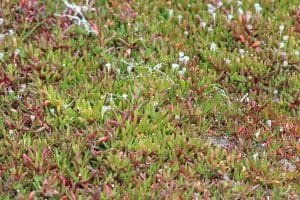
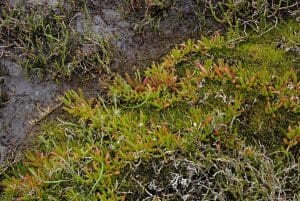
Salty Fingers are an absolutely outstanding species that grows at certain special coastal spots throughout the UK and the rest of the world. This one looks prehistoric and like it shouldn’t be eaten, however it has a delightful salty flavour and the way I best describe it is:
Imagine a grape went for a very long swim in the sea, tired itself out and came back to rest on the shore – and that’s it. A super salty crunchy grape 🙂
Common names
Pigface, Karkalla, Beach banana, Purple dew plant, Rounded noon-flower
Botanical Name
Disphyma crassifolium
Scientific Classification
Kingdom – Plantae
Order – Caryophyllales
Family – Aizoaceae
Physical Characteristics
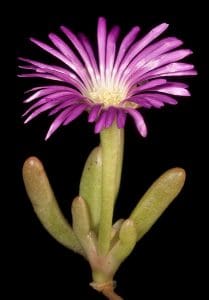
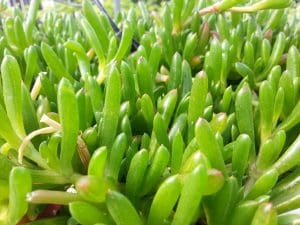
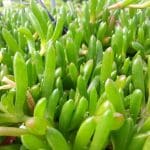
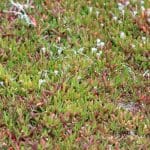
A creeping succulent plant with finger shaped leaves and daisy-like flowers rimmed in bright purple.
Leaves
The leaves are arranged in opposite pairs that tend to look more like clusters because new leaves grow from the leaf node.
Stems
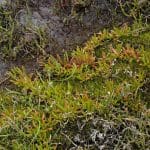
The stems are round and hairless and tend to be found creeping horizontally along the ground.
Flowers
The flowers are large, bright, and daisy-like, usually pink to purple, sometimes fading to paler shades toward the centre. The centre of the flower is yellow, packed with true stamens. Each flower has many narrow, petal-like structures (these are actually modified stamens), giving it a shiny, starburst appearance.
Habitat
This is a coastal, salt tolerant plant that can establish on rocks, walls, and disturbed ground very easily. It is found in Australia, New Zealand, South America and southern Asia, and has become naturalised across temperate coasts due to trade. In the UK it tends to be distributed along the warmer coasts and is particularly prevalent in Cornwall and Devon.
Known Hazards
None known.
It is an offence to plant or otherwise cause this species to grow in the wild because it can form dense mats in a similar manner to Hottentot Fig. So pick considerately, and be careful not to spread the seeds or break the rhizomes so that they can multiply below the soil.
Could be confused with
It could be confused with Hottentot fig (Carpobrotus edulis), but the leaf cross section of that plant are very triangular and much more bitter to taste.
Edible Use
The intense burst of saltiness given by popping one of these in your mouth is a welcome addition to a range of cooked and raw dishes, particularly alongside other seafood.
Some people say that freezing them to use as ice cubes in botanical gins makes a very aesthetically pleasing presentation. Because of the pleasing leaf arrangement around the stem, it makes a lovely, flavourful garnish.
Get to know this plant by taste throughout the year. When it flowers (March – July), the leaves can turn red and may become more bitter than you like.
When they’re green, the taste is quite simply a salty pop.
Notes on Herbal Uses
None explicitly mentioned, but assuredly a good source of minerals and salts.
Sources:
https://www.plantlife.org.uk/uk/discover-wild-plants-nature/plant-fungi-species/purple-dewplant
https://wildflowerfinder.org.uk/Flowers/D/Dewplant(Purple)/Dewplant(Purple).htm
http://www.seasonalwildflowers.com/purple-dewplant.html
Leave a Reply
You must be logged in to post a comment.