
Turkey Tails / All year round / Edible
Enter the realm of natural healing as we unveil the medicinal wonders of the Turkey Tails Mushroom (Trametes versicolor).
Join us on a journey where traditional medicine meets scientific exploration. With its colourful and intricate patterns resembling turkey feathers, the Turkey Tails Mushroom stands as a remarkable source of therapeutic potential.
Learn to identify its unique features, discover its preferred habitats, and delve into the medicinal benefits it offers. From its immune-boosting properties to its potential cancer-fighting compounds, this mushroom has been revered for its health-promoting qualities.
Whether you are seeking to support your well-being or embrace alternative healing practices, let the Turkey Tails Mushroom inspire you on your path to holistic wellness. Embrace the abundant gifts of nature as we celebrate the enchanting healing potential that lies within the Turkey Tails Mushroom. Get ready to embark on a journey of natural discovery as we explore the captivating medicinal possibilities offered by this remarkable fungus.
Common Names
Turkey Tails, Yun Zhi or Cloud Mushroom, Japanese Ladies Fan.
Scientific Name
Trametes Versicolor
Family
Polyporaceae
Habitat
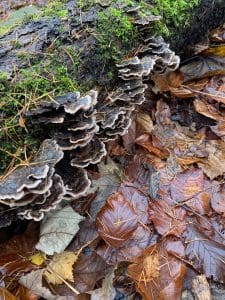
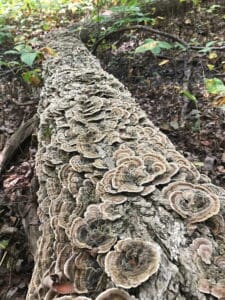
Found typically in many layers growing from decaying hardwoods trunks and stumps (occasionally on conifers).
Throughout mainland Europe, UK, Northern, and mainland America, and all over Asia.
Description
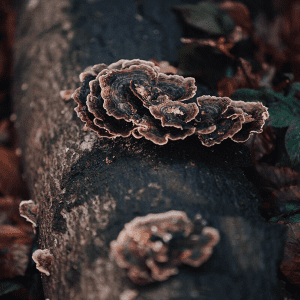
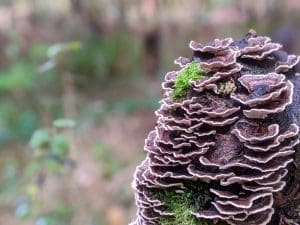
Turkey tail (Trametes versicolor) is a common bracket fungus with thin, fan-shaped caps marked by colourful concentric bands, growing in layers on dead or dying wood.
Identifying Features:
Upper surface:
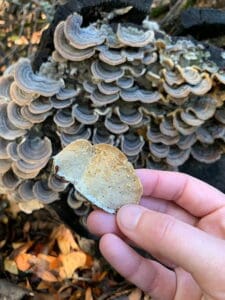
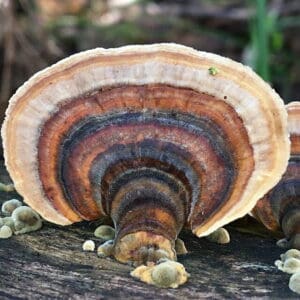
Very thin fungi 1-3mm thick, growing from wood in a semicircular fashion. The cap, 5-8cm, is of leathery texture and contains concentric zones or rings of different colours ranging from golden rust to dark brown and can often appear to have green algae growing around its edges, although the edges are often more of a cream colour.
Underside:
The underside and pore surface ranges from bold white to light brown, the pore’s themselves are round, 2-5 pores per millimetre. It is often found on dead hard woods and found growing in rows and large tiered clusters.
Known Hazards
None reported.
Potential lookalikes
Hairy Curtain Crust or the False Turkey Tail (Stereum hirsutum) – this fungi has a yellow rim and a yellow underside with a smooth spore-bearing surface rather than pores.
Trametes ochacea of which the colourful rings are typically light ochre whereas T. Versicolor has rings of different shades of brown and smaller pores.
Trametes suavoelens, which is lighter and doesn’t grow in such large overlapping clusters.
Uses
In food
Too tough to eat and best used to extract flavour. Eating whole fungi could lead to indigestion.
Notes on herbal usage
These fungi has a huge remit of medicinal and herbal uses, traditionally it has been used to increase circulation, for skin complaints, to help with arthritis, rheumatism, and gout. More recently this fungus has come under heavy research mainly in China and Japan for its immune-stimulating polysaccharides, specifically for their use in the treatment of cancer. Through these tests the fungi has shown some truly amazing results, enhancing the effects of radiation and chemotherapy, prolonging the activity of antibiotics and much, much more.
Extra notes from the foragers
Turkey tails can persist and remain for a long time on the log, make sure they’re fresh and not a remnant from the previous season (for both paper-making and food use) – a good way to tell whether they are fresh is that the edge and underside are still white, pale and spongy.
If you’re out in the woods you can use this fungus as a substitute for chewing gum – not for the taste specifically but more if you like the distraction of continually chewing something. After 30 minutes of chewing, you can set aside until you accumulate enough to make paper with.
According to Silvercord, as reported by Robert Rogers in his Fungal Pharmacy, the essence of this fungus “Is for the eternal worrier, for those who need to ground their energies into the physical world and for those who work with nature.”
You can extract and use a weak brown or greyish yellow colour from this fungi – it can be used for dying without a mordant and can be slaked with chalk, although the greyish-yellow comes through less dramatically this way.
Miriam Rice rates this fungus as the top one to use in papermaking, we agree it works well but the resulting paper can be dark and the fungus can be a pain to clean prior to use. Using it in conjunction with another fibre, such as nettle, increases the potential of this fungus for paper use dramatically.