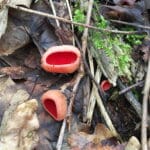
Venture into the captivating realm of Scarlet Elf Cups, a charming and visually striking group of fungi that enchant foragers and nature enthusiasts alike. These enchanting mushrooms, often found nestled in damp, wooded areas, are as delightful to observe as they are to consume.
Common Names
Scarlet Elf cup, scarlet cup fungus, moss cup, fairy bath.
Scientific name
Sarcoscypha austriaca
Family
Sarcoscyphaceae
Habitat
Commonly found on dead or decaying damp hardwood, specifically around mosses, lichens and leaf litter.
Description
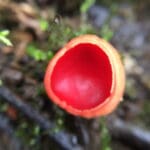
A striking, small cup fungus known for its vivid red, cup-shaped fruiting bodies. Typically found on damp, decaying wood during late winter and early spring.
Identifying features:
Cap:
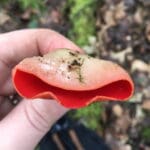
The fruit body, up to 5cm across is circular or oval, initially, it is cup-shaped, later becoming more disc-shaped. The inside of this fungi’s cup is a brilliant red with a smooth and shiny complexion. The outside of the cup and short stem range from a light pink to white and resembled a felted mass of extremely short hairs (under a microscope these are corkscrew shaped).
Stem:
It is connecting to the substrate with a small stem.
Smell:
Spores:
White spore print (under a microscope these are ellipsoidal with flattened ends containing several oil droplets).
Video of Scarlet Elf Cups Foraging
Known Hazards
Many fungi in the order Pezizales are toxic if consumed raw.
Potential lookalikes
This fungus is commonly confused with the macroscopically virtually indistinguishable Ruby Elfcup Sarcoscypha coccinea which is similarly edible. Microscopic examination of the latter reveals uncoiled hairs on the outer surface in contrast to coiled ones in the Scarlet Elfcup
Uses
In food
Whole fruit body cooked (raw with caution), although be sure to test your sensitivity by only eating a small amount at first – especially if eating raw. Fergus has eaten these raw (with out any problems) for 20 years, but never more than about 10 averaged sized fungi at a time.
One of the great things about this fungi is that its amazing colour isn’t lost during cooking and can therefore add a really nice contrast of colour to dishes. They work especially well floated on a consommés, and tossed in green leafy salads, as well as grain salads.
Herbal use
Carotanoids give this fungi is amazing colours, specifically beta-carotene and plectaniaxanthin – which are both noted to slow down the deterioration of eyesight with age.
Extra notes from the foragers
Sarcosypha is derived from the two Latin words – Sarco meaning flesh and Skyphos meaning drinking bowl. Austriaca refers to Austria.
It’s believed that the elves of the wood visit these cups in the morning and drink the dew from them. We like to pretend to be woodland elves, using these magical goblets to drink our sloe gin and birch sap from.
These striking fungi can often be found when collecting the season’s first wild garlic in February. A rarely recorded white coloured form and a bright yellow variety have also been reported.