


Laver / Spring / Summer / Autumn / Winter / Edible
Common Names
Nori (but not the varieties found in Britain)
Botanical Name
Porphyra spp, including umbilicalis, leucosticta, linearis. All these species are edible and functionally the same, and often professionals in science and foraging struggle to distinguish the precise species from each other. There are 60-70 species in the Porphyra genus.
Scientific Classification
Kingdom – Protista
Order –Bangiales
Family – Bangiaceae
Physical Characteristics
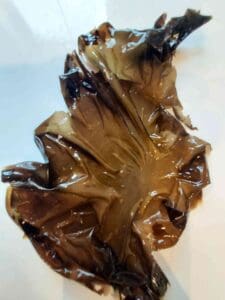
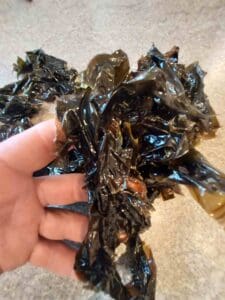
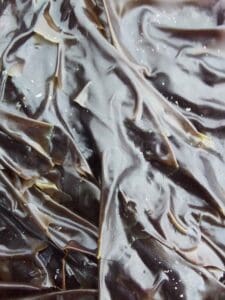
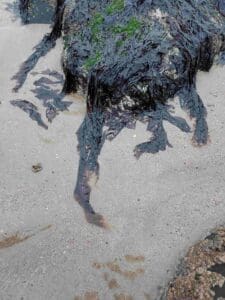
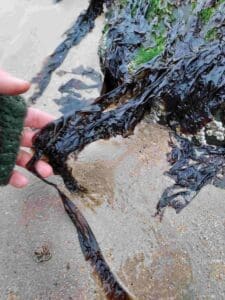
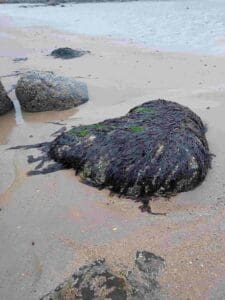
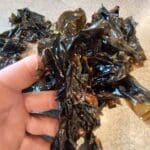
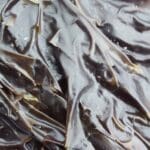
Laver is a darkly coloured red, often translucent group of seaweeds that can be almost black or quite light in colour. It usually grows in sheets on rocks, and where you find one growing you will usually find many more.
It is available for harvest all year round, however, make sure to leave the base of the seaweed in tact so it can regrow.
Habitat
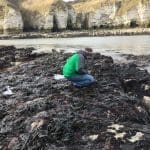
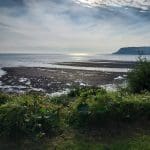
Common throughout the British Isles, found on rocky shores. It can tolerate long periods out of the water, so is to be found relatively high up the shore.
Known Hazards
As with most seaweeds, the high iodine content means that those with thyroid issues should be careful not to consume too much if they are already taking iodine supplements. Likewise, the salt content may be a problem for those who need to limit their salt intake. In general, there are more hazards associated with the environment you find it in than from the algae itself. It is wise to check water quality data from the Environment Agency (https://environment.data.gov.uk/bwq/profiles/ ) to see whether there are issues with chemical or sewage pollution in the water, and to rinse your harvested seaweed well with clean water to be on the safe side. You should also be aware of slippery or unstable rocks, and the possibility of the sea coming round quickly and cutting you off from land. Check the tide times, only harvest from areas you can get to safely, and take someone with you to get help if you get into difficulty.
Could be Confused with
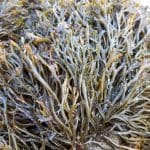
All Laver species closely resemble each other, with small differences in colour, thickness and translucency providing clues to identification. They are all edible. Dulse is sometimes confused with laver, but the latter tends to be darker in colour and grows directly on rocks, whereas dulse is often growing on other seaweeds as an epiphyte or from sandier, wetter rock pools. Dulse is also a bit thicker and is arranged in several finger-like fronds whereas laver tends to form single fronds.
Edible Uses
There is a very long and global history of using this seaweed is bread, soups and salads. Think laver bread from Wales (although more of a paste), and equivalents throughout the British Isles.
I think this is one of the easiest seaweeds to eat due to its fine texture and mild taste. Using it to wrap vegetable rolls, chunked into soups, pies, quiches is delicious and easy, but it can also be pickled, preserved and dried to make salts and mixed spices.
Notes on Herbal Uses
Like many seaweeds, this one has a tradition of being used by sailors to prevent goitre. This is linked to the generally high levels of iodine found in seaweeds, which supports thyroid, and therefore overall metabolic, health. This has repercussions for all other body systems, particularly for those involved in chronic illnesses.
Conservation Considerations
This is a common seaweed on Britain’s rocky coasts. As with any harvest, do not clear a whole patch and do cut it away instead of pulling it so that the rest of the alga has a chance of regenerating. Keep in mind that many other marine animals depend on Laver for shelter and food.
Extra notes from the Foragers
The British Laver is a close relative of the seaweed known as Nori, which is used to wrap sushi and flavour soups and salads.
Click here to explore more Seaweed guides
2 replies on “Laver Seaweed (Porphyra spp) Identification”
Leave a Reply
You must be logged in to post a comment.
Hi there,
Just noticed the following mistake:
“As for shellfish and other coastal harvests, there is a custom of refraining from harvesting when there is an ‘R’ in the month’s name – ”
It ought to be the other way around. Refrain during months NOT containing ‘R’.
Cheers,
Natalue
Thanks, Natalie, I’ll amend this now – thanks for keeping an eye,
For further reading, we use this guide for our seaweed harvesting guide 🙂
https://cdn.naturalresources.wales/media/686552/gn011-detailed-guidance-for-seaweed-harvesting-hand-gatheringenglish.pdf