


Sea Spaghetti / Spring / Summer / Autumn / Edible
Common Names
Sea spaghetti, Thongweed
Botanical Name
Himanthalia elongata
Scientific Classification
Kingdom – Chromista
Order –Fucales
Family – Himanthaliaceae
Habitat
Thongweed grows on hard substrates like rock and is to be often to be found between the wracks and kelps. It likes strong tidal exposure but is less likely to be found at exposed sites later in the year. If found growing on a rock, only harvest one of the two strands (never pull the button right off as the seaweed won’t be able to continue reproducing), otherwise, take what looks clean and fresh from what has washed up in the rockpools.
Found all around the western coasts of the UK and Ireland, as well as the eastern side of northern England. It can also be found on the western and northern coasts of France, Spain and Belgium.
Physical Characteristics:
Fronds
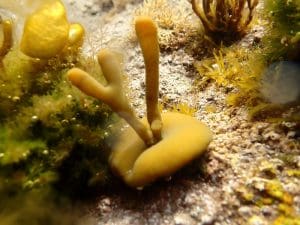
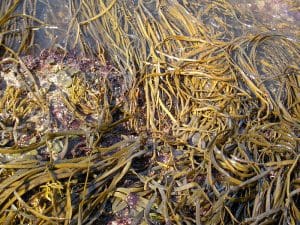
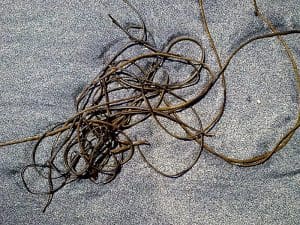
Sea spaghetti grows from a small brown button, producing two long, dark brown strands from April to October. The strands are long, flat and solid, and later in the year, they gain spots. They can be over a metre long.
Holdfast
The holdfast is small, discoid, and button-like, attaching firmly to rocks.
Known Hazards
As with most seaweeds, the high iodine content means that those with thyroid issues should be careful not to consume too much if they are already taking iodine supplements. Likewise, the salt content may be a problem for those who need to limit their salt intake. In general, there are more hazards associated with the environment you find it in than from the algae itself. It is wise to check water quality data from the Environment Agency (https://environment.data.gov.uk/bwq/profiles/ ) to see whether there are issues with chemical or sewage pollution in the water, and to rinse your harvested seaweed well with clean water to be on the safe side. You should also be aware of slippery or unstable rocks, and the possibility of the sea coming round quickly and cutting you off from land. Check the tide times, only harvest from areas you can get to safely, and take someone with you to get help if you get into difficulty.
Could Be Confused With
There are other seaweeds with long strands such as mermaid’s tresses/bootlace weed, but thong weed is notable by its flattened, solid structure whereas the former is a hollow tube.
Edible Uses
Thongweed is a sea vegetable of very diverse uses. It may be used, as its namesake suggests, as pasta after blanching in boiling water for 1-10 minutes (see how well done you like it), or included in pickles, fresh salads, chutneys, pies and sauces. As with other seaweeds, it may be powdered and used to thicken soups and stews. Forager Monica Wilde marinades her sea spaghetti in lemon juice or sea buckthorn juice for 10-20 minutes prior to cooking (see the link to her blog below).
Notes on Herbal uses
As with all seaweeds, sea spaghetti is very high in minerals and salts due to needing to retain enough water in a very saline environment. This makes it a wonderful tonic food, important in the maintenance of a thriving nervous, immune and just about every other body system. Consume in moderation – see the safety section above. Clinically (by medical herbalists), seaweeds are often used for skin and skeletal issues.
Conservation Considerations
From April-October the long strands will be growing – harvest them before they have developed too many spots which is the site of gamete (reproductive cells) release.
Thongweed is relatively robust, but cannot stand changes to water salinity and increases in suspended water sediment.
Extra notes from the Foragers
Thongweed, along with many other seaweeds, has been used commercially in agriculture as a source of fertilising nutrients.
Folklore suggested the long “strings” of the plant were gifts from the sea for hard times, appearing most abundantly after storms when food on land was scarce.
Click here to explore more Seaweed guides

Leave a Reply
You must be logged in to post a comment.