
Amethyst Deceiver / Summer / Autumn / Edible
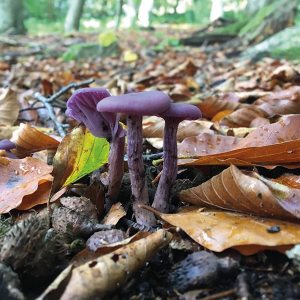
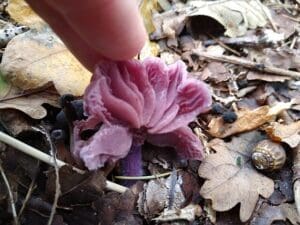
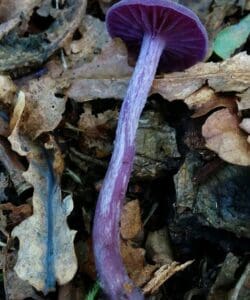
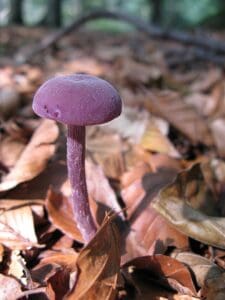

Welcome to our captivating blog post on identifying and foraging the Amethyst Deceiver (Laccaria amethystina), a delightful and eye-catching mushroom that adds a touch of vibrant colour to your wild edible harvests. This small yet stunning fungus, easily recognised by its striking violet hue and delicate gills, can be found in various woodland environments and is a fantastic addition to any forager’s repertoire.
In this post, we’ll explore the intriguing world of Amethyst Deceivers, delving into their unique features, preferred habitats, and the best times to find these enchanting mushrooms. We’ll also share invaluable tips and techniques for accurate identification and sustainable foraging practices, ensuring that you can safely and responsibly enjoy the bounty of these beautiful fungi. Lastly, we’ll provide some delectable culinary suggestions to help you savour the subtle flavours and striking appearance of the Amethyst Deceiver, elevating your foraged feasts to new heights. So, join us as we embark on this exciting journey into the colourful and fascinating realm of Amethyst Deceiver mushrooms!
Scientific Name
Laccaria amethystina
Family
Hydnangiaceae
Habitat
This mushroom, common in temperate areas of Europe, Asia and the Americas’ grows in deciduous as well as coniferous forests. I find them mostly with beech or oak. It appears in late summer through to early winter.
Description
This is quite a changeable mushroom and can appear different depending on weather conditions. So care must be taken when dealing with older specimens as the colour may have faded.
Why not check out our Amethyst Deceiver foraging video?
Identifying Features:
Cap:
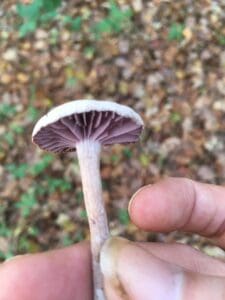
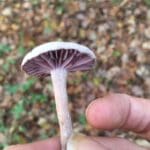
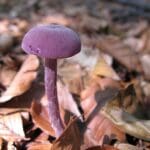
Convex to flattened, sometimes even with upturned edges. Lilac/purple when young then fading to tan/brown.
It can have a really wavy cap and completely faded cap – see images below
Stem:
Tough fibrous, twisted and quite often hollow, same colour as the cap.
Gills:
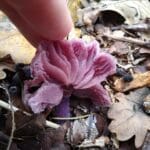
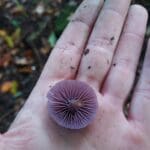
Lilac/purple when young fading to tan/brown with age. Widely Space with intermediate gills
Smell:
Mild mushroom scent
Spores:
White to Pale Lilac
Known hazards
The Amethyst Deceiver (Laccaria amethystina) is known to be a bioaccumulator of heavy metals, meaning it can uptake and store heavy metals from the environment. However, it is important to note that this characteristic is not exclusive to the Amethyst Deceiver, as many other fungi can also accumulate heavy metals.
Potential lookalikes
The potentially Deadly Inocybe (Geophylla lilacina), the Lilac Fibrecap (Inocybe Geophylla var. lilacina), but this mushroom has off white to grey gills whereas the amethyst deceiver has the same colour gills as the cap and stem.
Uses:
In food:
Can be used in a vast number of recipes, however, one of our favourites is simply fried quickly and stirred through white rice to give bright flecks of purple.
It has a pleasant mushroom flavour so works well in any dish. It keeps it purple colour when cooked so livens up any dish. The stems are quite tough so I only collect the caps.
Quite small but can be gathered in large numbers as they often appear in groups. The stems are quite tough and I personally only use the caps.
1 reply on “Amethyst Deceiver Mushrooms (Laccaria amethystina) Identification”