


Oarweed / Spring / Summer / Autumn / Edible
Common Names
Tangle, Red Ware, Sea Girdle, Leath
Botanical Name
Laminaria digitata
Scientific Classification
Kingdom – Chromista
Order –Laminariales
Family – Laminariaceae
Habitat
Kelps such as Oarweed grow in dense kelp gardens/forests, usually just beyond the rockpool line such that they spend most of their time submerged.
Found on most British and Irish coasts, as well as the Atlantic coasts of Europe.
Physical Characteristics:
Fronds
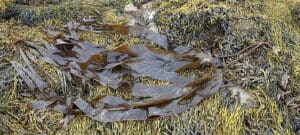
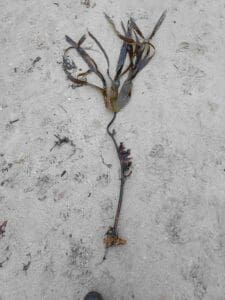
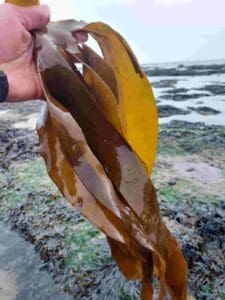
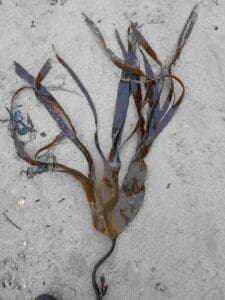
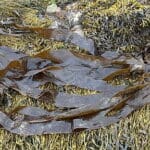
One of the kelps, Oarweed, has a long brown stipe (stem) with a smooth texture and oval cross-section, which differentiates it with forest kelp and others. The fronds can be up to 2m long and form glossy brown fingers that join in a palm towards the stipe.
Holdfast
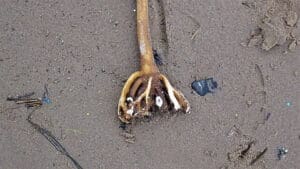
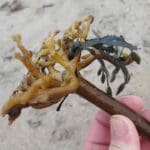
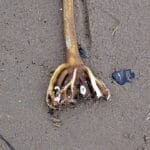
The holdfast is large, tough, and highly branched, made up of many finger-like projections called haptera.
Known Hazards
As with most seaweeds, the high iodine content means that those with thyroid issues should be careful not to consume too much if they are already taking iodine supplements. Likewise, the salt content may be a problem for those who need to limit their salt intake. In general, there are more hazards associated with the environment you find it in than from the algae itself. It is wise to check water quality data from the Environment Agency (https://environment.data.gov.uk/bwq/profiles/ ) to see whether there are issues with chemical or sewage pollution in the water, and to rinse your harvested seaweed well with clean water to be on the safe side. You should also be aware of slippery or unstable rocks, and the possibility of the sea coming round quickly and cutting you off from land. Check the tide times, only harvest from areas you can get to safely, and take someone with you to get help if you get into difficulty.
Could Be Confused With
Other Laminaria species like fores kelp are very similar, differing only in the texture and cross section of their stipe, which tends to be rougher in texture and circular in cross-section, and almost certainly has other seaweeds like dulse growing on it (epiphytes).
Edible Uses
Seaweeds are incredibly high in iodine, which can change the balance of your thyroid if you have a preexisting thyroid condition or take thyroid medicines. Eat moderately.
Like most of the other seaweeds, oarweed fronds lend themselves to grilling, frying, baking, drying, powdering and adding to almost anything you can think of. People have definitely even tried adding them to chocolate, which probably creates a lovely flavoursome alternative to salty caramel. The fronds will snap when bent, meaning that while when fresh they are quite slimy with a layer of carbohydrate, they are not chewy, and therefore create a lovely mouthfeel. You could try using them as lasagne sheet substitutes, or make a powder for use as a soup and stew thickener. They will lend themselves well to chutneys, ferments and other preserves that need a natural source of sodium glutamate. Always eat in moderation – see the safety section above.
April – October. As with all seaweeds, only take fronds that look healthy, fresh and free of infection, biofilm and other blemishes.
Notes on Herbal uses
As with other seaweeds, oarweed is an amazing source of minerals and micronutrients many of us lack with modern industrial food. Clinically it might be used in skin conditions, hormonal imbalances and skeletal issues.
Conservation Considerations
While kelps are fairly common, make sure that you only cut the fronds from plants that are still attached to their rock, as they can live for 4-6 years and continue reproducing. They are quite sensitive to non-native species entering their ecosystem, but luckily seem to be less sensitive to temperature increases.
Extra notes from the Foragers
The number and size of the fronds indicates how exposed the kelp has been; the more and longer, the greater the exposure. Each plant can live for 4-6 years.
Click here to explore more Seaweed guides


Leave a Reply
You must be logged in to post a comment.