


Serrated Wrack / Spring / Summer / Autumn / Winter / Edible
Common Names
Toothed wrack, Saw wrack
Botanical Name
Fucus serratus
Scientific Classification
Kingdom – Chromista
Order –Fucales
Family – Fucaceae
Habitat
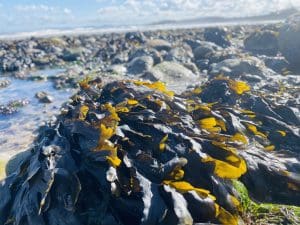
Found mostly on hard substrata low on the shore, especially on more sheltered coasts.
They are found throughout British and Irish coasts and notably on the coast of France and the southern tip of Sweden.
Physical Characteristics:
Fronds
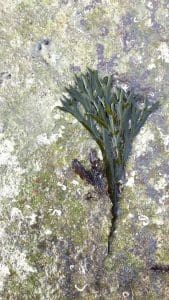
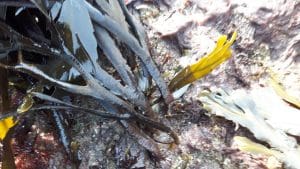
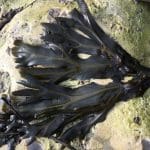
A larger wrack that can grow to 60cm long.
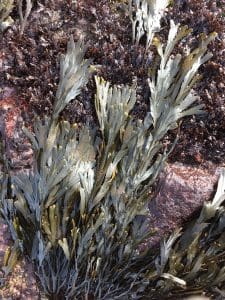
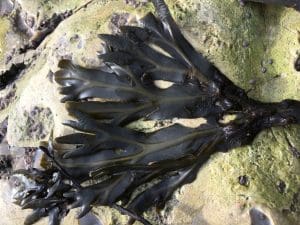
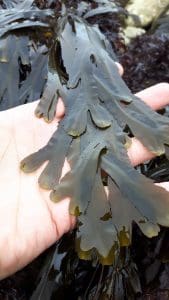
This is a brown seaweed with dark, wiry stems and slightly lighter, flat straplike fronds with distinctive serrations or teeth along the edges.
The frond tips are slightly roughened in texture.
Above the tips there is a distinctive midrib.
Toothed wracks grow thickly on the rocks low on the shore.
Holdfast
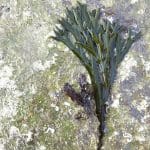
The holdfast is small, discoid (disc-shaped), and tough.
Known Hazards
As with most seaweeds, the high iodine content means that those with thyroid issues should be careful not to consume too much if they are already taking iodine supplements. Likewise, the salt content may be a problem for those who need to limit their salt intake. In general, there are more hazards associated with the environment you find it in than from the algae itself. It is wise to check water quality data from the Environment Agency (https://environment.data.gov.uk/bwq/profiles/ ) to see whether there are issues with chemical or sewage pollution in the water, and to rinse your harvested seaweed well with clean water to be on the safe side. You should also be aware of slippery or unstable rocks, and the possibility of the sea coming round quickly and cutting you off from land. Check the tide times, only harvest from areas you can get to safely, and take someone with you to get help if you get into difficulty.
Could Be Confused With
This wrack is distinctive due to its flat strap-like frond tips and serrated edges.
All the other wracks are edible.
Edible Uses
The flat frond tips make good additions to salads, stir fries, sandwiches and anything else that needs a salty kick.
All the wracks make a very good soup thickening and flavouring agent when dried and powdered. Ensure complete drying for best results.
These seaweeds along with other wracks actually make a really nice pickle, I usually cut the top 5cm off and use those bits, pop them straight in a jar and pour over your favourite pickling liquor, hot. It will partially cook them but now make them mushy. The resulting pickle is fantastic.
Being lower on the shore, this wrack should be harvested during the two hours around low tide.
Cut the tender tips away from the more wiry stems.
Notes on Herbal uses
Brown seaweeds are high in iodine, and were traditionally used for goitre. Use seaweeds as a tonic food – little and often – to optimise nutrient levels and promote good health long term.
Conservation Considerations
This is a common seaweed.
Only harvest what you need, never stripping an entire patch.
Take only the tips, leaving the rest of the algae to complete its life cycle.
Extra notes from the Foragers
Folklore warned that cutting too much saw wrack at once could bring bad weather, reinforcing sustainable harvesting long before modern conservation ideas.
Click here to explore more Seaweed guides
Leave a Reply
You must be logged in to post a comment.