


Mallow / Spring / Summer / Autumn / Edible
A common hedgerow plant. It can be found in many areas of the world. It’s non-native to the UK and was most likely introduced by the Romans.
Common Names
Mallow, Round Dock, Common Mallow, High Mallow, Cheeses, Custard cheeses, Fairy cheeses, Lady’s Cheese and Truckles of Cheese.
Botanical Name
Malva sylvestris
Scientific Classification
Kingdom – Plantae
Order – Malvales
Family – Malvaceae
Physical Characteristics for Mallow
Leaves
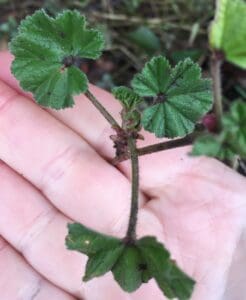
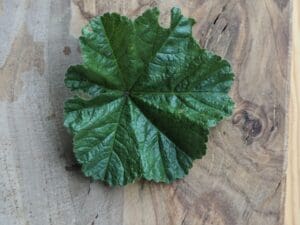
The leaves are roughly round to pentagon in shape, they have 5 lobes and are rather crinkly. They often have a reddish/ burgundy dot in the centre of the leaf helping to distinguish them.T hey are hairy and are around 5-10cm in diameter.
Flowers
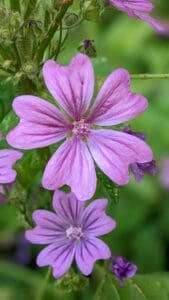
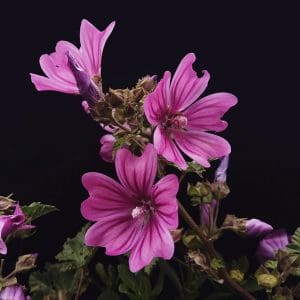
The flowers are pink to purple in colour with darker stripes running along their length. They are roughly trumpet shaped with 5 heart-shaped petals. It flowers between June to October, flowering stems grows to to between 60 cm to 1.5 m.
Fruits
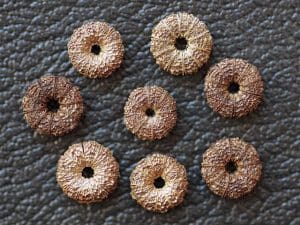
The seeds are known as ‘cheeses’ and are shaped like a wedge of cheese. Together the seeds look a little like a trivial pursuit counter.
Habitat
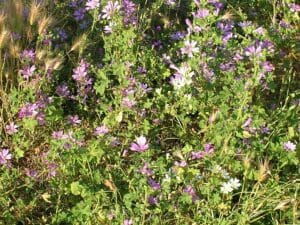
It is a perennial plant that is most often its found in hedgerows and on disturbed ground.
Known Hazards
None known
Could be Confused with
Could also be confused with Ladies mantle (Alchemilla vulgaris), which are more grey in colour, lack the darker central leaf spot and have yellow flowers. Ladies mantle Is not poisonous anyway
Some Geranium species can have similar looking leaves but they will have a strong, herbal smell when crushed. Mallow lacks any real smell. The flowers look quite different too.
Edible Uses
The leaves when young can be added to salads, when they get older and tougher they can be cooked as a leafy green. The leaves will puff up and go crispy, a bit like prawn crackers when deep fried to add texture to meals.
The ‘cheeses’ have a lovely nutty flavour and can be eaten raw straight off the plant or added to pestos for example.
The flowers don’t have much flavour but be can be used as a striking garnish or to brighten up salads.
Notes on Herbal Uses
The leaves and seeds are high in mucilage and have been traditionally used to treat inflammation.
The leaves are also used to treat external wounds as a poultice.
Teas made from the seeds can be used to form a soothing film over a mucous membrane, relieving minor pain and inflammation of the membrane.
Extra notes from the Foragers
The leaves and seeds can be used for dying, they produce a yellow to green coloured dye.
In Jewish culture it is considered one of the most important wild plants and its common name in Hebrew and Arabic translates to ‘bread’.
You’ve met the plant — now let’s see if you can recognise it.
Click on the image below and try our quiz to check your understanding of the key ID features.
Resources
https://www.wildlifetrusts.org/wildlife-explorer/wildflowers/common-mallow
https://www.permaculture.co.uk/readers-solutions/benefits-common-mallow-malva-sylvestris
Leave a Reply
You must be logged in to post a comment.