


Channel Wrack / Spring / Summer / Autumn / Winter / Edible
Common Names
Channel Wrack
Botanical Name
Pelvetia canaliculata
Scientific Classification
Kingdom – Chromista
Order –Fucales
Family – Fucaceae
Habitat
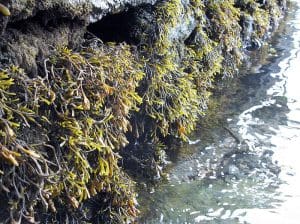
Channel wrack is one of the first wracks that you tend to find as you move from land to water. It likes to be firmly within the splash zone, and can blanket large areas of rock. It is found around the rockier shores of Britain, such as west Wales, Scotland, and is widely found on the west coasts of Ireland and France.
Physical Characteristics:
Fronds
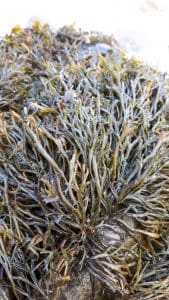
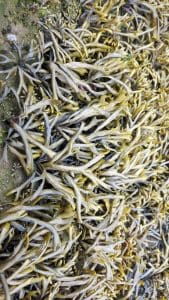
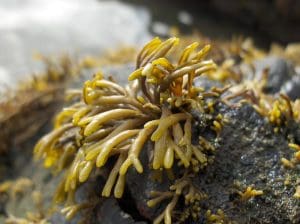
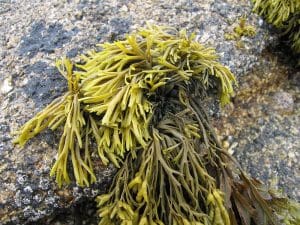
Brown seaweed with a dark, wiry stem opening out into a handful of fronds, each roughly 5-15cm long.
The fronds form swollen V-shaped tips that are much lighter in colour, approaching yellow.
The fronds each have a distinct channel in them caused by curling of the edges, hence the name.
This wrack lacks a midrib and bladders containing air.
Holdfast
The holdfast is small, disc-shaped, and flattened.
Known Hazards
As with most seaweeds, the high iodine content means that those with thyroid issues should be careful not to consume too much if they are already taking iodine supplements. Likewise, the salt content may be a problem for those who need to limit their salt intake. In general, there are more hazards associated with the environment you find it in than from the algae itself. It is wise to check water quality data from the Environment Agency (https://environment.data.gov.uk/bwq/profiles/ ) to see whether there are issues with chemical or sewage pollution in the water, and to rinse your harvested seaweed well with clean water to be on the safe side. You should also be aware of slippery or unstable rocks, and the possibility of the sea coming round quickly and cutting you off from land. Check the tide times, only harvest from areas you can get to safely, and take someone with you to get help if you get into difficulty.
Could Be Confused With
Channel wrack is distinguishable from the abundant other kinds of wrack by its presence in the splash zone at high tide, and the elongated bladders at the frond ends that turn yellow and are therefore distinctive from a distance.
It is also slightly smaller than other wracks. All the wracks are edible, and there are no seaweeds currently found on the coasts of Britain that are toxic.
Edible Uses
The juicy tips of channel wrack make good additions to salads, stir fries, sandwiches, quiches, pies and soups. A common use is as a thickening, flavouring agent for broths and stews, to which channel wrack lends its savoury, umami flavour. Dehydrate the seaweed before grinding into a powder, or toast under a grill for a delicious snack.
Best harvested between May and August.
Cutaway only the softer tips; nearer to the holdfast they get wiry and tough.
They are available all year round, so it becomes a matter of preference whether you are happy to pick winter wracks.
Around August – September the seaweed’s gametes are released from the frond tips into the water for external fertilisation
Notes on Herbal uses
The brown wrack seaweeds are high in iodine and have historically been used for goitre. These are brilliant tonic foods and should be eaten in moderation on a regular basis to ensure optimal nutrition.
Conservation Considerations
This is a very abundant seaweed that tolerates desiccation well.
Never strip an entire patch, and only take the tips, leaving the rest of the algae to complete its life cycle.
Extra notes from the Foragers
This wrack can die if exposed to water for too long, although it needs submersion to obtain nutrients. It grows more slowly than other wracks that live further down the shore, meaning it is out competed closer to the water.
Click here to explore more Seaweed guides
Leave a Reply
You must be logged in to post a comment.